Monday, 18 June 2012

Andy Hamilton's delicious gooseberry wine | Life and style | guardian.co.uk

Andy Hamilton's delicious gooseberry wine | Life and style | guardian.co.uk

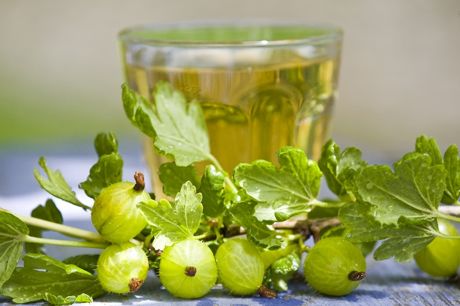
GOOSEBERRY WINE
Ingredients
2kg Gooseberries
1.3kg Sugar
4 litres water
Half teaspoon pectolase (ask at your homebrew shop)
1 teaspoon yeast nutrient
1 packet champagne yeast
Wash and top your gooseberries then freeze them overnight – this will help split them to release more flavour. Place into a fermenting bin and crush using a sterilized potato masher. Pour over half of the water and boil the rest with the sugar before pouring that over, too. Ensuring the temperature has cooled to room temperature add the yeast nutrient.
Set aside for 12 hours before adding yeast and pectolase. Leave in a warm place for a week. Strain into a demijohn and leave to ferment out – which in the summer months can be as quickly as one month and up to about three.

Apple Wine Recipe | Permaculture Magazine

Apple Wine Recipe | Permaculture Magazine

Seasonal, Easy and Heavenly Gooseberry Jam | Permaculture Magazine

Seasonal, Easy and Heavenly Gooseberry Jam | Permaculture Magazine

Ingredients

4 lbs (1.8 kg) gooseberries
1.7 pints (1 litre) water
6 lbs (2.7 kg) sugar

Method

Top and tail the gooseberries. Put the fruit and water into a preserving pan or a big saucepan with a heavy base. Be careful not to add too much water. If your fruit is ripe, add less. Bring to the boil and simmer gently until the skins are soft. Then add the sugar slowly on a low heat, allowing it to dissolve. Be careful not to put it all in at once and boil before the sugar has dissolved as it may crystallise during storage. Once dissolved, bring the jam to a rapid but steady boil and boil until it reaches a temperature of between 105°C and 110°C. This should take about 15 minutes unless you have added too much water.
Wash some jam jars in hot soapy water and rinse well. You can put them into a preheated oven at 160°C/fan140°C/gas 3 until you
are ready to use them but I never bother. I just make sure they are very clean.
I own an old brass kitchen thermometer and along with my preserving pan, it is a treasured possession given to me by my mother-in-law. I suggest you see if an elderly relative has one surplus to requirement or seek one out at a car boot sales. I find it invaluable for wine and jam making. It tells me exactly when I have reached setting temperature.
If you don't have one you can do a wrinkle test. Place a saucer in the freezer when you start the jam. Take a teaspoon of the jam and put it on the saucer. Let it go cold. Then push it across the plate with your finger. If it is ready it will wrinkle up. If not, keep on boiling the jam mixture for a few more minutes.
Once you have set the jam take it off the heat and let it sit for a while so that it stops boiling. Then ladle it into jars. Again, I have a special funnel which saves a lot of mess and makes ladling a quick and clean process.
Leave to cool. Label. Enjoy!

Friday, 11 March 2011

This Years Tomatoes

Ok - decided on tomatoes -  Tangella, Legend, Merveille de Marches, Gardener's Delight, Tigerella & Roma.  Though I've read good things about Sungold...

Wednesday, 19 January 2011

Transition Durham

Please come along to our first special event for 2011 on Jan 29th at Alington House from 5pm til late. The event marks the soft launch of our new local food website, a celebration of Transition Durham registering as an official Transition group, a tour of our Fruit Map, Bread tasting from Elizabeth's new community bakery, a seed swap area, and a party to celebrate all these things (including Elizabeth's birthday)

Here's what's happening in more detail...
Start and arrive at 5pm doors open with tea, coffee, cake, an Imbolc (first signs of spring) welcoming and some bread tasting from Elizabeth who is planning to set up a community bakery this year.
There will also be a seed swap table, please bring your spare seeds to swap and share seed news
Then the main part of the event...
Starting at about 5.30pm there will be presentations, an overview and introduction to Transition and demonstration of the Transition Durham website, followed by the main presentation - a guided tour of our new local food website (which is not yet public but you'll get to see it first in its "started but not finished state" at this event)
We will then see the latest from the Fruit Group and their mapping adventures of 2010 and their fruit tree nursery plans for 2011.
There will also be brief news from other groups and projects including the Local Economy Project and Durham Exchange
From 7pm there will be food ready provided by Fiona of Jam Jhar and Foodcycle (donations will be welcome). This will be topped up with a bar, music and even a live band (the Future Primitives) taking us into a party mood and maybe even a bit of dancing!
For the earlier part of this evening event we will have laptops around connected to Alington Houses super fast Wi-fi so that you can explore our new websites, get to know them, make comments, contribute and maybe even get involved
By 11pm it will be time to go home or stay and tidy up
We hope to see you there. Please come and help us celebrate. Bring a friend who is new to transition and local food. Please forward this invite to your groups or folk who maybe interested and kids / families are welcome to come along as there is lots of space!
Alington House can be found at 4 North Bailey in Durham, DH1 3ET

Tuesday, 11 January 2011

First day at the allotment 2011. Everything pretty much flattened by the heavy snow. Some green shoots coming through the spinach, so cut back all the soggy leaves and covered with fleece. Had planned to harvest some Celariac but under the foliage there was no root of any size. Won't bother with it next year. Ditto Christmas potatoes of which there were none!

Managed to bring back some brussels sprouts which the pigeons had kindly left, and a few
parsnips. Definite hit of the winter is red cabbage 'Red Jewel' which is still crisp and bright, and has been harvested since Sept.

Saturday, 20 February 2010

Fruit & Vegetables -- RHS Prints


wonderful prints to buy from the RHS, from £15 unframed
Fruit & Vegetables -- RHS Prints

GardenShows.com


Good round up of plant fairs and horticultural shows throughout the UK in 2010

GardenShows.com

YouTube - Cheap starter pot made from newspaper.


I've made these for the last couple of years. You can vary the sizes by using broadsheet/tabloid newspapers and they feed neatly into seed trays for carrying to the plot.

YouTube - Cheap starter pot made from newspaper.

Thursday, 21 January 2010

Monday, 11 January 2010